 About Cesbank
ENDOTHELIUM
Bullous Keratopathy is a pathological condition which affects the cornea in which small vesicles, or bullae, are formed in the cornea due to endothelial dysfunction. Bullous keratopathy more often occurs in old age and has been addressed as the most common disease affecting the cornea in old age.
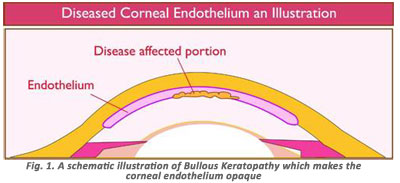 Corneal Transplantation is an effective approach to restore vision for such conditions.
Though the cornea has three well defined components, until recently, even for a partial damage of the cornea i.e. damage of one of the three components, the whole cornea was transplanted.
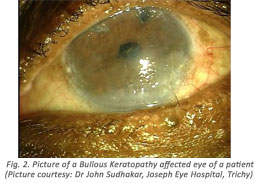
Endothelium was considered to be a very sensitive single layer of cells. Even growing mature endothelial cells in the laboratory was considered to be difficult.
Endothelium being a sensitive layer of cells could be damaged even when a lens removal procedure is done or could get damaged with aging and no regeneration by natural repairing process was found to be occurring for its recovery.
With this background, when a cadaver eye (dead donors cornea) is obtained it will be used for transplantation to only one prospective recipient (needy patient) with the technology presently being used worldwide.
To overcome this, NCRM and their collaborating institutes have developed a new technology called ICE-TUBE (In-vitro expanded Corneal Endothelial precursors- Transplanted Using Blis-film: Eye-for-eyes mission).
In this method, when a donor corneal specimen which is adjudged infection-free, but unsuitable for transplantation due to lesser than optimal corneal endothelial cell density by the eye bank, that corneal endothelial tissue could be separated from the cornea, transported to a central lab, in vitro cultured several folds and be transplanted to more than one eye of several patients using a nano-composite gel scaffold (BLIS-FILM; Bio-inert Low IgG Sensitive - FILM). This BLIS-FILM scaffold supports the transplanted cells hold close to the disease affected endothelium so that they get engrafted and the patient doesn’t have to lie down with eye-down position for several hours with its support to the cells. The ICE-TUBE procedure has been tried in a clinical pilot study with one cadaver-donor cornea derived endothelial tissue help restoring the vision in three patients.
When the entire system becomes well established, there is no need that every small clinic/hospital in small villages/periphery to have a stem cell processing laboratory with elaborate investments and infrastructure, but a central lab within reach by 24-36 hrs logistics facility that too in room temperature preservation of the cells can serve a large surrounding area making things affordable to common man.
PUBLICATIONS:
- Parikumar P, Haraguchi K, Senthilkumar R, Abraham SJ. Human corneal endothelial cell transplantation with nanocomposite gel sheet preserves corneal stability in post-corneal transplant bullous keratopathy: a 16-year follow-up .Am J Stem Cells 2024;13(3):162-168. doi: 10.62347/CBYH7014
- Parikumar P, Haraguchi K, Senthilkumar R, Abraham SJ. Human corneal endothelial cell transplantation using nanocomposite gel sheet in bullous keratopathy .Am J Stem Cells. 2018 Feb 1;7(1):18-24
- Parikumar P, Haraguchi K, Ohbayashi A, Senthilkumar R, Abraham S. Successful transplantation of in vitro expanded human cadaver corneal endothelial precursor cells on to a cadaver Bovine's eye using a Nanocomposite gel sheet. Current Eye Research. Posted online on October 21, 2013. doi:10.3109/02713683.2013.838633
- Sudhakar J, Parikumar P, Natarajan S, Insaan A, Yoshioka H, Mori Y, Tsukahara S, Baskar S, Manjunath S, Senthilkumar R, Thamaraikannan P, Srinivasan T, Preethy S, Abraham S. Successful Transportation of Human Corneal Endothelial Tissues without Cool preservation in varying Indian Tropical climatic Conditions and in vitro Cell Expansion using a novel Polymer. Indian J Ophthalmol. 2013.
- Green DW, Watson GS, Watson J, Abraham S. New Biomimetic Directions in Regenerative Ophthalmology. Adv. Healthcare Mater. 2012, DOI: 10.1002/adhm.201100039. http://www.ncbi.nlm.nih.gov/pubmed/23184716.
- Namitha B, Chitra MR, Bhavya M, Katoh S, Yoshioka H, Iwasaki M, Senthilkumar R, Rajmohan M, Karthick R, Preethy S, Abraham SJK. A novel human donor cornea preservation cocktail incorporating a thermo-reversible gelation polymer (TGP), enhancing the corneal endothelial cell density maintenance and explant culture of corneal limbal cells . Biotechnology Letters 2021. doi:10.1007/s10529-021-03116-y
- Abraham S, Farzana BL, Majunath S, Shrieff AK, John S, Jesudasan C.A.N, Philip T, H.Yoshioka, Y. Mori, Amano S. Successful transport and in vitro expansion of corneal endothelial precursor cells, using a novel thermogelation polymer(TGP). ASIA ARVO, Singapore, 2007.